
Providence Living is part of a story that began long before its incorporation. Rooted in the charism of the Sisters of St. Joseph and nurtured through generations of Catholic health care ministry, it carries forward a mission that has shaped communities across British Columbia for more than a century. This enduring charism, a gift of the Spirit, continues to inspire women and men to respond to the needs of the “dear neighbour” with compassion, courage, and love.
Providence Living emerged from a decades‑long discernment shared by leaders across Providence Health Care (PHC) in Vancouver and St. Joseph’s General Hospital in Comox: a desire to transform long‑term care (LTC) for older adults in British Columbia into a social-relational approach that prioritizes resident-directed living and meaningful relationships over traditional institution-like settings. In doing so, they were not beginning a new story but carrying forward a much older one, seeking to express the same mission in ways that respond to the realities and opportunities of our time.
The vision of Providence Living is shaped by the charism of the founding congregation, the Sisters of St. Joseph, and by their long history of care for those in need, including in communities across British Columbia. Understanding their charism as a gift of the Spirit continues to guide how care is imagined, expressed, and lived today. Indeed, by knowing our roots we can recognize our fruits in how we respond to concrete human need.
These roots are both spiritual and historical. In places such as the Comox Valley, the Sisters of St. Joseph gave concrete expression to their call to love the “dear neighbour” through caring for the sick, the elderly, and those most in need—often in modest beginnings, with limited resources, and in close relationship with the communities they served. Over time, this ministry grew and adapted alongside changing needs, while remaining grounded in a consistent spirit of compassion, dignity, and unity.
This charism, expressed across generations through service, attentiveness, and a willingness to respond to emerging needs, continues to guide Providence Living today. It is not only something we inherit—it is something that comes alive again and again in response to the needs of each time and place.
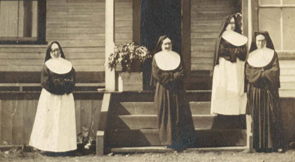
Providence Living carries forward the Sisters’ legacy.
A Shared Calling to Serve: Providence Health Care and St. Joseph’s General Hospital
Providence Health Care’s Founding Story
In the late 1800’s Vancouver was a new city that was expanding rapidly. In response, Bishop Paul Durieu of the New Westminster Diocese, requested that the Sisters of Providence of Montreal come to Vancouver to help provide care – most especially to those who were vulnerable or living in poverty.
In 1894, five sisters arrived with minimal possessions and a mandate to serve with “humility, simplicity and charity.” They opened St. Paul’s Hospital as a 25-bed four-story hospital to help meet the needs of the new city – paying special attention to those who were marginalized. Their doors were open to all, and no one was turned away. Over the coming decades, St. Paul’s would grow and expand and by 1997, it merged with CHARA Health Care Society and Holy Family Hospital to form Providence Health Care as we know it today.
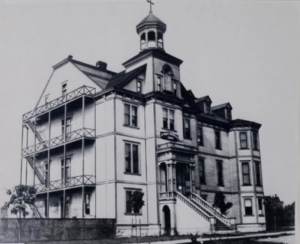
Original St. Paul’s Hospital c. 1894
St. Joseph’s General Hospital Founding Story
While the Sisters of Providence were providing care in Vancouver, the Sisters of St. Joseph from Toronto began care in the Comox Valley. In 1913, Sisters Majella, Claudia, St. Edmund and Praxedes opened a small, four-bed infirmary in a farmhouse which quickly expanded over the years as St. Joseph’s General Hospital. Their response was shaped by the charism of the Sisters of St. Joseph—rooted in loving the “dear neighbour” without distinction and fostering unity with God and one another. In the Comox Valley, this took concrete form: caring for those in rural and often underserved communities, responding to local need with limited resources, and building relationships that would shape the culture of care for generations. This was never an abstract ideal, but a practical, relational way of serving—grounded in presence, attentiveness, and community.
Just as leaders at Providence Health Care began to recognize the need to transform seniors care, the team at St. Joseph’s also shifted focus to seniors’ care – opening a long-term care home called The Views at St. Joseph’s. But it soon became clear that to make significant improvements to care for older adults, a brand-new organization might be needed. Over time, this ministry in British Columbia grew alongside the needs of the community—evolving from a small infirmary into a broader expression of Catholic health care. Yet throughout this growth, the core spirit remained consistent: a commitment to dignity, relationship, and responding to those most in need.
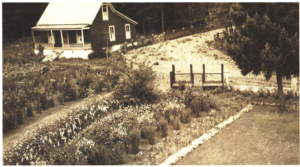
Original cottage; first hospital and home of the four founding Sisters of St. Joseph’s
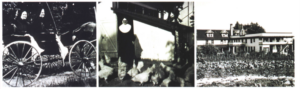
Democrat buggy used for transportation by the Sisters (c. 1913); Sister coming out of the chicken coup – 200 chickens were raised at one time; a vegetable garden in front of the 1915 wing and 1923 addition of St. Joseph’s Hospital
A Shared Struggle: The Limitations of the Hospital Act
As an operator of both acute and long-term care sites, PHC is bound by a legal governance framework called The Hospital Act. While ensuring regulated care standards, the act also prevents operators from borrowing money, carrying debt, or expanding beyond their regional health authority geography. This created operational barriers as it meant that PHC could not take on debt to construct a purpose-build facility to better serve an aging population. Leaders began to feel deep moral distress over four‑bed units and outdated environments that no longer reflected the Providence mission or values. At its core, the question became one of faithfulness: How do we continue to respond to the needs of our time in a way that is true to the charism we have received? At its heart, this was not only an operational challenge—it was a question of how to ensure the charism could continue to take shape in ways that honoured dignity, relationship, and the full humanity of those served.
This moment echoed a pattern seen throughout the history of the Sisters of St. Joseph—where new realities called for new forms of response. From their early ministries in places like the Comox Valley to the evolving needs of long-term care in British Columbia, the question was always the same: how to remain faithful to the spirit of the mission while adapting to the needs of the time.
By the early 2000s, multiple leaders across PHC senior leadership and governance recognized a stark truth: PHC could not become the LTC leader it aspired to be unless a new, separate entity was created, one free from the restrictions placed on acute‑care hospitals, through the Hospital Act. A new entity could also expand beyond the Vancouver geography, allowing it to serve populations where the need was greatest.
The desire to support vulnerable older adults was rooted in PHC’s identity from its founding congregations. But the organization faced a dilemma:
How can we transform seniors’ care when the structure of the system itself prevents us from accessing capital, or moving to areas of the greatest need within BC?
Meanwhile in Comox: St. Joseph’s Faces a Crossroads
At the same time, a similar journey was unfolding on Vancouver Island.
St. Joseph’s General Hospital — once one of the last independent Catholic hospitals in the province — found itself at a turning point when Island Health announced the creation of a new regional hospital, shifting acute care away from the Comox site. St. Joseph’s leadership realized the time had come to discern a new identity and purpose for their 14‑acre campus, which had been purchased and held by the Sisters of St. Joseph and ultimately by the Bishop of Victoria since 1913.
Through deep community consultation, one message emerged unmistakably: The future of St. Joseph’s lay in long-term care for older adults. This discernment reflected the enduring charism of the Sisters of St. Joseph—attentive to the needs of the “dear neighbour,” and responsive in ways that foster dignity, belonging, and community. In this way, charism was not something remembered from the past, but something actively discerned in response to present need. This discernment was shaped not only by present circumstances, but by a long history of ministry where generations of Sisters and staff had already established a culture of relational, person-centered care. In this way, the history of St. Joseph’s in British Columbia directly informed the future that was being imagined.
St. Joseph’s had a strong legacy of compassionate, person‑centered care. Residents and families described their LTC home, The Views, as a place where people felt known, cared for, and treated with dignity — a culture that closely aligned with PHC’s values.
The Conversations That Sparked a Movement
Leaders from both organizations began engaging in thoughtful dialogue together.
They asked bold questions:
- What if we worked together to build something entirely new?
- What if we could become a provincial leader in care for older adults?
- What if we could finally build the model of care we have always envisioned — one rooted in dignity, compassion, autonomy, and home?
These conversations were marked by patience, humility, and a willingness to imagine structures that did not yet exist. Yet practical barriers emerged: if St. Joseph’s transferred ownership of its land and operations to PHC, the Hospital Act would once again block access to capital and delay redevelopment.
The solution became clear: A completely new society was needed, one independent from the Hospital Act, capable of borrowing money, and free to grow province‑wide.
2017–2018: The Birth of Providence Living
Between 2017 and 2018, with the support of the Ministry of Health, along with Bishop Gary Gordon of Victoria and Archbishop Michael Miller of Vancouver, PHC and St. Joseph’s officially came together to create a new legal entity: Providence Living Society. This decision required significant courage from boards and sponsors, who agreed to create an organization with no operational history but deep moral clarity.
This new organization would:
- carry forward the Catholic health care mission
- focus exclusively on long‑term care and services for older adults
- leverage Church‑owned lands for mortgages and redevelopment
- be independent from the Hospital Act
- serve communities across British Columbia, not just PHC’s traditional geography.
Government support was strong. Health Minister Adrian Dix was an early advocate, seeing clearly the need for innovation in seniors’ care well before the COVID‑19 crisis illuminated systemic gaps. The birth of Providence Living represents a living expression of charism: a willingness to allow forms to change so that the mission may endure and respond to present need.
A Mission Rooted in Compassion, Courage, and Innovation
Providence Living was envisioned not simply as another LTC provider, but as an intentional re-imagining of older adult care that could include:
- Small households instead of institutions
- Autonomy, choice, and daily life with meaning
- Outdoor spaces, cooking, community, and connection
- A shift from risk‑avoidance to embracing real life
This model reflects both the charism and the history of the Sisters of St. Joseph. Just as the early Sisters lived and worked among the people they served—adapting their response to local needs—so too does this model seek to create environments where care is relational, responsive, and grounded in everyday life.
The philosophy drew inspiration from dementia‑village models, from the Sisters’ long legacy, and from PHC’s and St. Joseph’s tradition of compassionate, relationship‑centered care.
One of the first major projects — Providence Living at The Views — embodied this vision. It created spaces where residents could choose their meals, go outside in the rain if they wished, participate in household tasks, and experience true home‑like rhythms. Families described it as a place where they not only visited their loved ones — they lived life with them.

Providence Living at The Views
Vancouver Sites: Cooper Place and Central City Lodge
As Providence Living’s vision evolved, additional opportunities emerged, particularly in Vancouver’s Downtown Eastside. Two significant additions were Cooper Place (CP) and Central City Lodge (CCL), both of which presented unique challenges and opportunities.
Cooper Place and CCL came to Providence Living’s attention when their operators—facing organizational strain and increasing patient complexity—sought a values-aligned organization to assume oversight. Leaders recognized these sites served some of the most marginalized populations in the province, especially individuals navigating addictions, mental health challenges, and social vulnerability.
Taking on CP and CCL was not without difficulty. While different from Providence Living’s original vision, these sites became a compelling expression of mission—responding to need where vulnerability was greatest.
These Vancouver sites presented new ways to broaden the organization’s reach, bring the patient-centered model of care to marginalized communities, and explore new expressions of mission in urban contexts.
Why Providence Living Was Needed
-
To transform long-term care
Leaders were driven by moral distress about outdated LTC environments. They believed seniors deserved better: privacy, meaningful life, freedom, and compassionate care.
-
To break free from structural barriers
PHC could not redevelop LTC as long as it was bound by the Hospital Act. A new society with its own governance and borrowing ability was essential.
-
To expand the mission province-wide
The founding congregations’ call to serve vulnerable older adults extended beyond Vancouver. Providence Living allowed the mission to grow into Comox, Prince George, Smithers, Quesnel, and beyond.
-
To safeguard and renew the Catholic health care mission in long-term care
The Sisters’ founding mission and the Church’s continued call to care for elders made it clear that Catholic long‑term care required intentional stewardship. Creating Providence Living was a deliberate act of foresight: to ensure the ministry would strengthen and adapt with integrity.
A Legacy of Two Organizations, One Mission
Archbishop Miller of Vancouver captured the identity of Providence Living and Providence Health Care as two deeply connected organizations following “one mission with two expressions.”
Though separate entities, the two organizations – Providence Health Care and Providence Living – remain deeply connected through shared values, leadership collaboration, and a commitment to innovation and compassionate care.
This vision becomes real through the people who live it each day. Across Providence Living, staff and leaders carry forward a legacy shaped by the Sisters of St. Joseph and their long history of service in British Columbia. Through attentiveness to change, steadiness in moments of difficulty, creativity in responding to need, and kindness in everyday care, charism is not only remembered—it is made visible in daily life.
The Story Continues
Today, Providence Living stands as a testament to courage, creativity, and the power of collaboration. It is shaped by:
- years of discernment
- pressure to evolve with changing demographics
- the prophetic voice of older adults and their families
- the courage of boards, bishops, and leaders
- a belief that older adults deserve joy, home, and dignity.
It is the story of how two organizations — PHC and St. Joseph’s — recognized that together, they could build something neither could achieve alone.
Providence Living stands not as a finished model, but as an ongoing act of discernment—faithful to tradition, responsive to the present need, and open to what the future asks of elder care. This is how charism lives on—not only in structures or history, but in the decisions, relationships, and daily acts of care that continue to shape Providence Living today.
This is how charism lives on—not only in structures or history, but in the decisions, relationships, and daily acts of care that continue to shape Providence Living today, building on a legacy first lived by the Sisters of St. Joseph and carried forward across communities in British Columbia and beyond.

“The women who are our past have bequeathed to us a strong heritage: the courage to respond in the most difficult situations, the humility to let God be with people through us, the fidelity to God and to one another from which we derive our strength.” (Constitution)